20 Jul 2026
Nano Banana 2 vs Nano Banana 1: Character Consistency Compared
Introduction
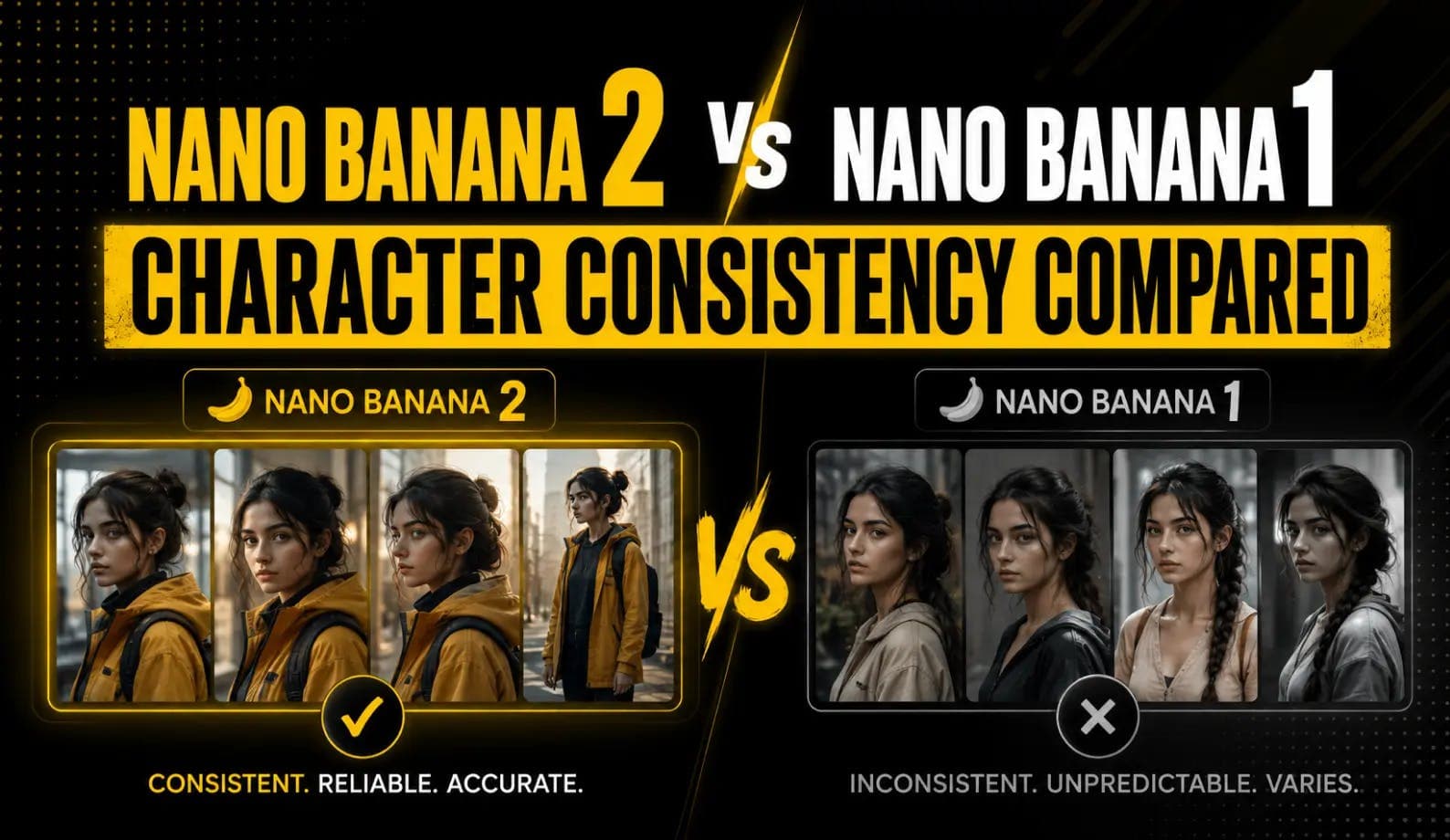
Character consistency was the headline feature that made Nano Banana famous — and it was also its most common complaint. Faces drifted. Add a third character and the whole scene got muddy. When "Nano Banana 2" arrived, the promise was that this exact weakness got fixed. Did it? This comparison puts the two generations head-to-head on the one thing that matters most for storytelling, comics, and branded content.
First, a definitions note — because "Nano Banana 2" is used loosely and it causes real confusion. If you're new to the family, start with what Nano Banana is, then read on. For the deeper mechanics of how Nano Banana maintains character consistency, that pillar post covers the underlying architecture.
Clearing Up the Naming First
There are three models in play, and the market blurs them together. Here's the canonical breakdown:
The cleanest comparison this article makes: Nano Banana 1 (Gemini 2.5 Flash Image) vs the Gemini 3 generation as a whole (Nano Banana Pro + Nano Banana 2 / 3.1 Flash). When people say "Nano Banana 2" in tutorials and forums, they usually mean the Gemini 3 generation — Pro and 3.1 Flash together.
The Spec-by-Spec Comparison
What actually changed for character consistency, drawn from Google's own documentation. Blue-highlighted cells indicate where Gemini 3 wins; green-highlighted cells indicate where Nano Banana 1 wins.
| Spec | Nano Banana 1 (Gemini 2.5 Flash) | Nano Banana Pro / 2 (Gemini 3) |
|---|---|---|
| Consistency Headline | Maintain character consistency across environments and angles | Blend up to 14 images and maintain the consistency and resemblance of up to 5 people |
| Reference Inputs | Multi-image blend (no published hard cap) | Up to 14 total |
| Consistent People | Not published | Up to 5 (Pro) / Up to 4 (3.1 Flash) |
| Output Resolution | ~1024px | 2K and 4K |
| Reasoning Engine | Fast / efficient | Gemini 3 advanced reasoning + real-world knowledge |
| Text in Images | Good | Best-in-class legible, multilingual text |
| Price Per Image | $0.039 (official) | ~$0.134 at 1K–2K; ~$0.24 at 4K (third-party estimate) |
| Speed | Faster — Flash-optimised | Slower (Pro); moderate (3.1 Flash) |
Google's exact words from the Nano Banana Pro announcement:
With Nano Banana Pro, you can blend more elements than ever before, using up to 14 images and maintaining the consistency and resemblance of up to 5 people.
That's the official ceiling — directly addressing the multi-character weakness in v1.
What the Upgrade Actually Fixes
Three practical improvements matter for consistency work:
- Multi-character scenes hold together. The single biggest v1 pain was more than one or two people. Pro's explicit "up to 5 people" guarantee is the direct fix — group scenes, family portraits, and ensemble comics stop degrading.
- Higher resolution reduces face drift. At 2K/4K, fine facial detail survives editing that would soften or shift at ~1024px. Sharper inputs and outputs give the model more identity to anchor to across generations.
- Stronger reasoning reduces "logic drift." Gemini 3's real-world understanding helps the model keep a character coherent as the scene changes — the right hairstyle in the rain, the same tattoo at a new angle.
For the mechanics of feeding those references correctly, see our guide on using reference images for consistency — the naming and 2–4 reference discipline applies equally to both model generations.
Where Nano Banana 1 Still Makes Sense
The newer generation isn't automatically the right pick. Cost and speed still favour v1 in clear situations:
- v1 is ~3.5× cheaper per image ($0.039 vs ~$0.134). At volume, that gap is enormous. Thousands of images per month at Pro pricing adds up fast.
- v1 is faster — the Flash model is optimised for throughput, not detail.
- Single-character work rarely needs Pro. If you're keeping one face consistent at web resolution, v1 handles it well and costs a fraction as much.
Use Pro when the scene is complex — multiple people, 4K output, print work, or dense legible text on-image. Use v1 for high-volume, single-character, web-resolution content.
Quick Decision Guide
| Your Scenario | Best Pick |
|---|---|
| One character, web images, tight budget | Nano Banana 1 |
| Two to five characters in one scene | Nano Banana Pro / 2 |
| Print, 4K output, or heavy on-image text | Nano Banana Pro / 2 |
| Thousands of images at scale | Nano Banana 1 |
| Mixed single + multi-character in one pipeline | Nano Banana Pro / 2 |
The Scale Behind the Comparison
This isn't a niche tool. Nano Banana crossed 5 billion+ images generated by January 2026, and Nano Banana Pro hit 1 billion images in under two months, per Google's announcement. The consistency improvements shipped into a model people were already using at massive scale — which is why the upgrade got so much attention.
One caution: figures like "95% character consistency" or "40% better retention" circulate on third-party marketing blogs but do not appear in any official Google source. Treat those as vendor claims, not facts. The official specs are the 14-image / 5-people numbers from the Pro announcement.
See the Difference
This tested workflow shows Pro-generation consistency in action, so you can judge the improvement against your own use case:
Also worth watching:
Frequently Asked Questions
What Is Nano Banana 2?
"Nano Banana 2" commonly refers to the Gemini 3 generation of Google's image model — Nano Banana Pro (Gemini 3 Pro Image) and Gemini 3.1 Flash Image. It's the successor to the original Nano Banana (Gemini 2.5 Flash Image). For the full introduction, see our explainer on what Nano Banana is.
Is Nano Banana 2 Better at Character Consistency?
Yes, especially for multiple characters. It officially maintains the resemblance of up to 5 people and blends up to 14 reference images, versus the original's less-specified limits. Higher 4K resolution also reduces facial drift across generations.
How Much More Does Nano Banana Pro Cost?
The original runs $0.039 per image officially. Pro is estimated around $0.134 per image at 1K–2K and ~$0.24 at 4K on third-party pricing pages — roughly 3–6× more expensive. Verify current rates on Google's official pricing page before committing.
Should I Always Use the Newer Version?
No. For single-character, web-resolution, high-volume work, the original Nano Banana 1 is cheaper and faster. Reserve Pro for multi-character scenes, 4K/print output, or heavy on-image text requirements.
How Many Characters Can Stay Consistent?
Up to 5 people with Nano Banana Pro, and up to 4 with Gemini 3.1 Flash, per Google's official docs. The original Nano Banana (v1) did not publish a hard number.
Pick the Version That Fits the Job
The upgrade is real where it counts — crowded scenes, 4K, and text — but it's not a blanket "always use the new one." Match the model to the job: base Nano Banana 1 for cheap, fast, single-character volume; Pro when the scene gets complex. Test both on your own character and let the cost-per-image math decide.